

Crypto donations are not just for major donors. They are for all donors, including everyday donors.
At Every.org, our goal is simple: make it easy for donors to give in whatever way they choose. That means supporting a wide range of payment methods — from credit cards and ACH to donor-advised funds, stock, PayPal, Venmo, and crypto. Because we process so many different kinds of gifts, we are in a unique position to observe how donors actually behave across these payment types.
When we first began processing crypto donations at Every.org in December 2020, we assumed crypto gifts would be rare, massive, and driven almost entirely by ultra-wealthy donors.
An analysis of five years of data on crypto donations on Every.org tells a different story — one that is far more nuanced and encouraging.
Since its inception, Every.org has processed 4,269 crypto donations totaling $66 million. These donations have come from 1,865 donors supporting 1,144 nonprofits. Growth has been dramatic, especially in the past two years.
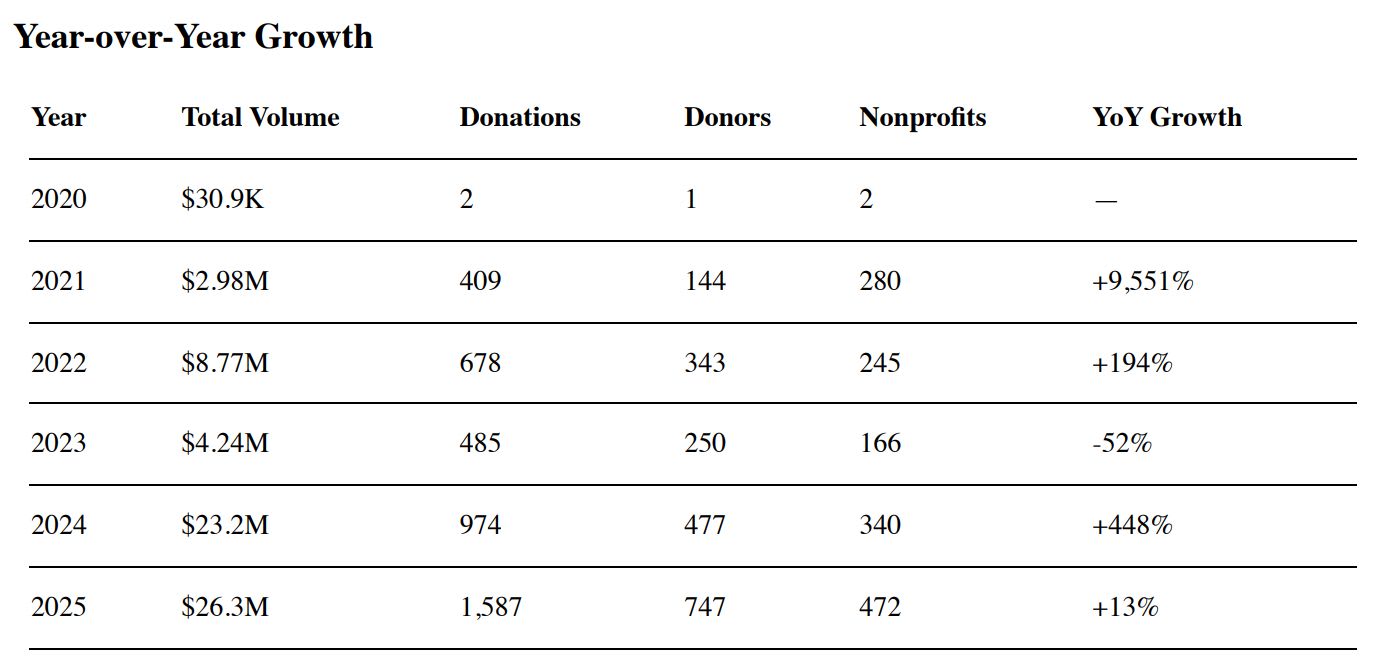
In 2023, crypto giving dipped significantly during the bear market and post-FTX fallout. In 2024, it rebounded sharply as markets strengthened and institutional confidence returned. This kind of volatility is not unique to crypto philanthropy. It is consistent with all asset-based giving. Stock gifts fluctuate with markets. So does crypto.
The key for nonprofits is not to fear fluctuations, but to be ready for them. This is what we call infrastructure readiness.
The growth over time is impressive, but that wasn’t the most surprising part. Here’s the real question: if I asked you to guess the median size of these gifts, what would you say? $10,000? $100,000? Maybe even $1,000,000?
It’s $140.
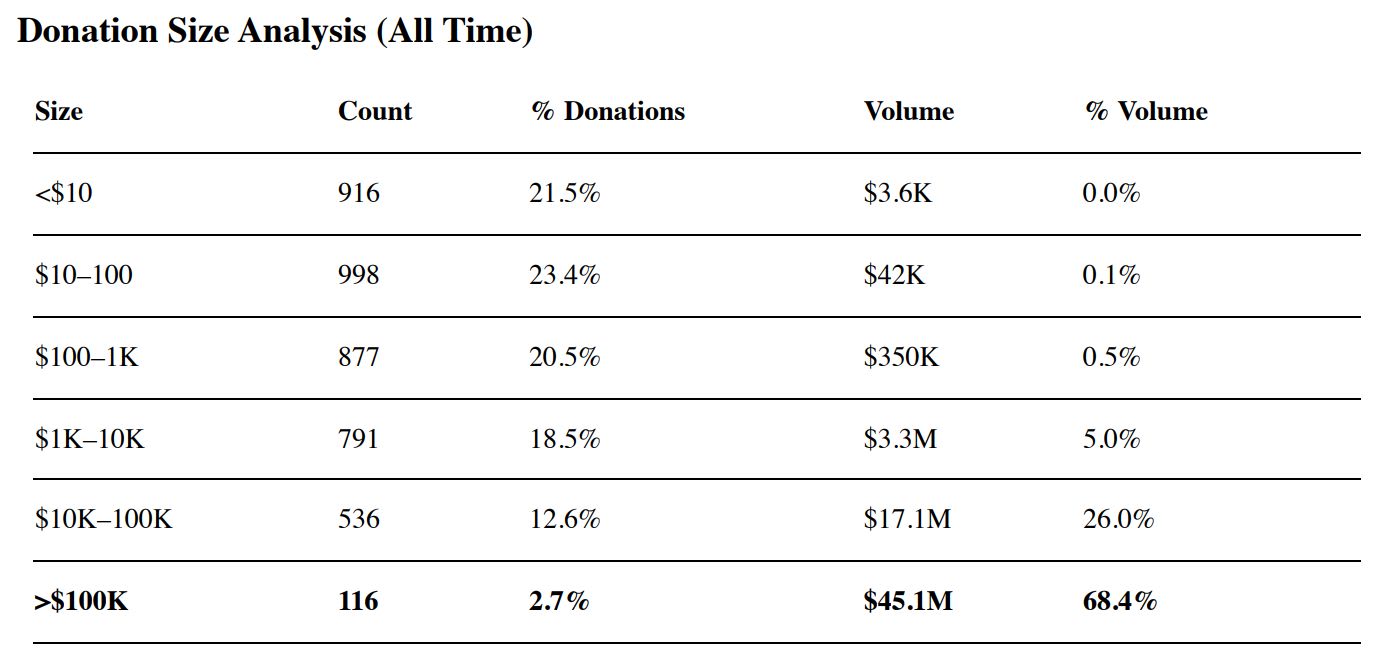
Crypto philanthropy is not just billionaires making enormous gifts. It increasingly includes ordinary donors giving appreciated assets in the same way they might donate stock.
And that matters for nonprofits that still hesitate to add a crypto donate button.
Looking at the overall distribution, a small percentage of donations account for a large percentage of dollars — just as in every form of fundraising. Crypto follows the normal rules of giving; it doesn’t create new ones. In fact, 65% of crypto donations on our platform are under $1,000.
Nearly 45% of all crypto volume occurs in Q4, and December 31 alone accounts for 4.3% of all-time giving. In this way, crypto donations behave exactly like other non-cash assets, such as stock.
Not only are crypto donors more modest than many assume, but the nonprofits receiving these gifts are not just national brands. Many have budgets under $5 million. Crypto donors are supporting faith communities, animal welfare groups, global health organizations, local nonprofits — the full spectrum of mission-driven work.
Adding a crypto donate button is not a gamble; it is a practical step toward making sure your donors can give in the ways they prefer. It ensures that when a donor experiences a liquidity event, reviews year-end tax planning, or simply feels moved to give, your organization is ready.
And in a moment defined by urgent need and constant crises, making generosity easier is not optional. It is a responsibility.